
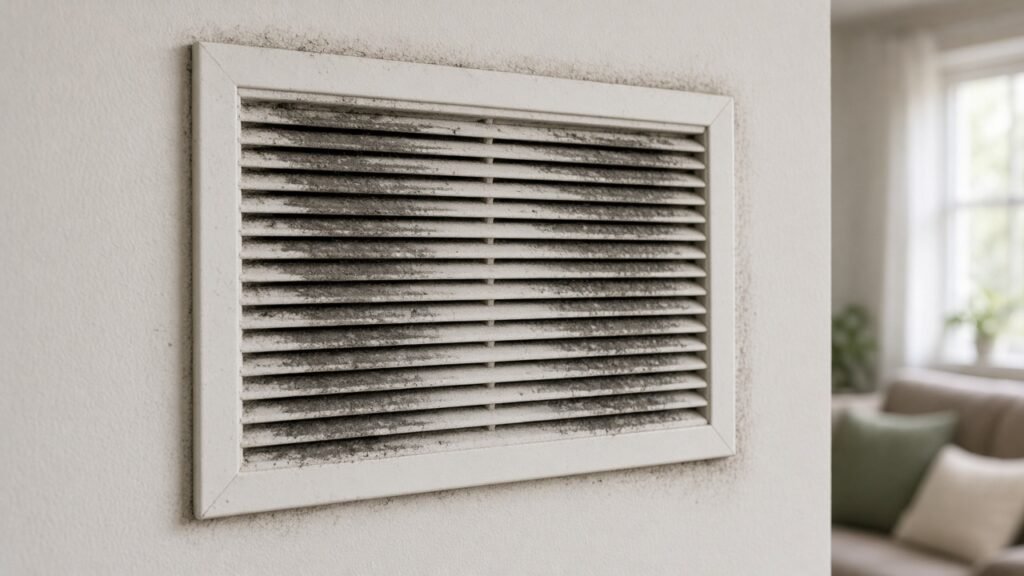
People ask: is this mold or dirt on my vent? Short answer: the black film on a supply or return grille is often ordinary dust and soot. HVAC air moves fine particles all day. They stick to the slats. Mold is more likely when that same grille stays damp, feels fuzzy or slimy, or the room smells musty when the system runs.
Look first: dry, powdery gray film on a dry register is often ordinary dust. Fuzzy, slimy, or damp growth is more consistent with mold. If you need to know which — or you need a lab record for a landlord — swab a 2×2 inch patch of that grille. Do not scrape or wipe growth that might be mold. Disturbing it can release spores. The swab identifies the grille surface. It cannot see down the duct.
The EPA’s duct-cleaning page does not recommend cleaning ducts on a routine schedule. Dirty-looking registers are not automatic proof that the whole system is growing mold.
By the Total Testing Editorial Team
Quick takeaways
- Dry, powdery gray or black film on a vent is commonly dust, lint, or combustion soot.
- Mold needs moisture. Look for dampness, a musty odor, or a slimy or fuzzy texture. Do not scrape the grille to “test” it.
- A swab of the grille IDs the grille. It is not a duct inspection.
- EPA: skip routine duct cleaning unless there is substantial visible growth inside the system, pests, or debris blocking airflow.
Dirt, soot, and mold — how they look on a register
| Typical dirt / soot | More consistent with mold | |
|---|---|---|
| Texture | Dry powder on a dry grille | Fuzzy, velvety, or slimy; smears |
| Moisture | Register is dry | Cool vent sweats; nearby drywall or insulation is damp |
| Odor | Dusty, or none | Musty when the fan turns on |
| If you need a name | Optional. Dust is common on dry vents. | Swab the grille. Share the lab report. Do not scrape it. |
This is a field check, not a lab result. Combustion soot (from candles, cooking, or a fireplace) can look very dark and still be dirt. If the mark might be mildew on a nearby wall instead, see mold vs. mildew.
Why vents collect gunk
Supply registers blow air. Return grilles suck air. Both catch household dust. A slightly cool supply in humid weather can also sweat, which is the moisture mold needs. That is why a bathroom or basement vent is a better suspect than a dry living-room grille with the same gray film.
If the house smells musty but you see nothing on the walls, start with musty odor with no visible mold, then check the registers the air actually touches.
When a lab swab of the vent makes sense
Swab the grille if you need a name for that surface — for yourself, a landlord, or a remediation professional — and you can reach a stained or damp edge. Turn the system off. Sample a 2×2 inch patch. Label it “hallway supply vent,” not “HVAC system.”
Do not scrape, bleach, or wipe growth that might be mold. A lab swab of an HVAC vent is a common way to document what is on that grille. More: do I need to test if I can already see it?
What a swab cannot tell you about ducts
A consumer swab does not map the air handler, the flex duct, or the coil. EPA’s position is that routine duct cleaning is not required for a healthy home. Consider a professional look inside the system when:
- You can see substantial mold growth on interior duct surfaces or components, not just film on the cover.
- There is a pest infestation in the ducts.
- Debris is actually blocking airflow.
Leaks at the air handler, a wet condensate pan, or a musty smell only when the AC runs are HVAC-plus-moisture problems. Those need a technician or a licensed assessor, not only a mail-in grille swab.
How to sample a register if you choose to
- Turn the fan off. Remove the grille if it comes off easily, or swab the slats in place.
- Pick the worst 2×2 inch edge — damp seam or fuzzy spot, not random clean metal.
- Use a clean swab, bag, and the package-specific PDF Chain of Custody form. Details: how to collect a surface mold sample.
- Ship with prepaid FedEx. The report posts to total-testing-diy.com after lab receipt.
Packages if the grille is the question
- Spot Check ($189 / 2 samples): One vent plus a nearby stain, or two registers. 48 business hour lab turnaround after receipt.
- Extended ($215 / 4 samples): Several rooms of supplies and returns. 48 business hour lab turnaround after receipt.
- Full House ($270 / 6 samples): More coverage. Priority 24 business hour lab processing after receipt.
Every package includes accredited laboratory analysis, the PDF Chain of Custody form, and prepaid FedEx shipping. This is preliminary surface screening, not a duct inspection.
Official product screening disclaimer
Total Testing DIY surface swab kits are a preliminary screening tool for accessible surfaces such as register covers. They are not a comprehensive mold assessment, HVAC inspection, indoor air quality study, or medical test.
If growth may be inside the system, if moisture is hidden, or if the area is large, use a licensed professional under your state and local rules.
Frequently asked questions
Is the black stuff on my air vent mold or dirt?
Often it is dust, lint, and soot that HVAC air leaves on the grille. Mold is more likely if the register stays damp, feels slimy or fuzzy, or the room smells musty when the system runs. A lab swab of that grille can identify the surface for you or a landlord. Do not scrape or wipe growth that might be mold. The result is the grille, not the ducts.
Should I have my air ducts cleaned if the vent looks dirty?
EPA does not recommend routine duct cleaning. Consider professional duct work if there is substantial visible mold growth inside the ducts or on other components, a pest infestation, or debris that is actually clogging airflow — not just gray film on a register cover.
Can I swab the vent myself?
Yes, if you can reach a stained or damp edge on the grille. Swab a 2×2 inch patch, label it, and send it with your chain of custody form. Turn the system off first so the swab does not blow away. The result is only that grille surface.
When should I call a professional instead of using a kit?
Call a licensed mold assessor or HVAC professional if you see growth inside the duct, if several rooms smell musty when the system runs, if you find a leak at the air handler, or if anyone has a building-related health concern you think is tied to the system.
Document the grille. Do not scrape it.
Most dirty vents are dirty. Moisture is what turns a register into a mold surface. If you cannot tell — or you need a lab record of that exact grille — swab it. Leave removal to a qualified mold remediation professional.
Packages: total-testing.com/packages.