
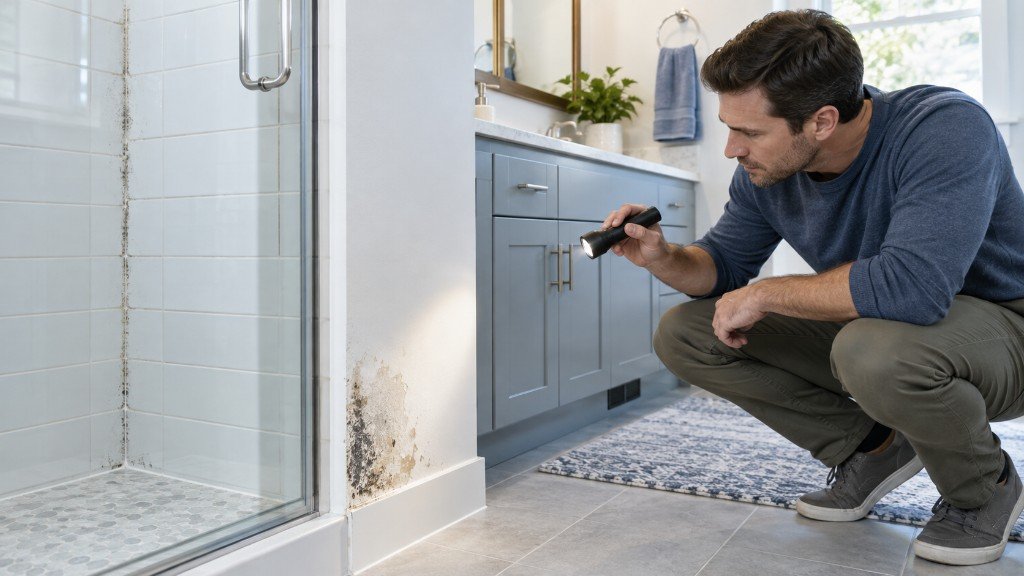
When you spot discoloration on a bathroom tile, windowsill, or basement wall, it is natural to ask: Is this just surface mildew, or am I dealing with active mold? While both belong to the fungi family and thrive on damp indoor surfaces, a lab swab of that patch is how you stop guessing — especially if you need a record for a landlord or a species ID before you hire remediation. Do not scrape or wipe the growth yourself.
At Total Testing, our core philosophy is simple: Test Before You Guess. Here is a comprehensive, practical guide on how to tell mold and mildew apart with total confidence.
By the Total Testing Editorial Team
Quick Executive Summary
Color, texture, surface depth, and odor help you tell mildew from mold. Here is the practical takeaway:
Core Takeaways:
- Mildew is a superficial fungal growth that stays on non-porous surfaces, appearing flat, powdery, or film-like in shades of white, gray, or yellow.
- Mold penetrates deeper into porous materials like drywall, wood, and carpet padding, featuring fuzzy, slimy, or velvety textures in dark green, black, blue, or brown.
- Do not scrub mildew or mold yourself. Disturbing growth can release spores. Swab the patch, then hire a qualified mold remediation professional for removal.
- Avoid over-the-counter open-air culture dishes that trap harmless ambient air spores. Direct surface swab sampling sent to an accredited laboratory provides definitive species identification.
- Always manage indoor relative humidity between 30% and 50% and repair water leaks within 24 to 48 hours in accordance with EPA and CDC guidelines.
What Is Mildew vs. What Is Mold?
Both mold and mildew are microscopic fungi that reproduce by releasing lightweight spores into the air. In nature, fungal organisms perform a vital role by breaking down decaying organic matter. However, when fungal spores land on damp indoor surfaces, they begin digesting the building materials they inhabit.
Although the terms are often used interchangeably in casual conversation, microbiologists distinguish between them based on visual structure, surface penetration, and growth habits:
- What Is Mildew? Mildew refers to early-stage or surface-level fungal growth. It typically colonizes flat, damp, non-porous surfaces such as shower curtains, bathroom tiles, window sills, and plant leaves. Mildew remains on the outer layer of a material.
- What Is Mold? Mold represents a more robust, multi-cellular fungal structure. Molds grow microscopic filament structures called hyphae, which act like roots. These hyphae dig beneath the surface of porous building materials such as drywall, wood framing, subflooring, and insulation, making full removal much more complex once established.
4 Key Differences Between Mold and Mildew
If you are inspecting a suspicious patch in your home, pay attention to these four primary visual and physical characteristics.
1. Visual Appearance and Color
The visual pattern is often your first hint:
- Mildew Appearance: Mildew begins as tiny powdery or downy specks that spread into flat, film-like patches. It usually starts out white, pale gray, or light yellow, sometimes aging into a dull brown or light black dusting on non-porous tile or grout.
- Mold Appearance: Mold exhibits a much richer variety of textures and colors. It frequently looks fuzzy, cottony, velvety, or slimy. Colors range from deep black and dark forest green to navy blue, bright orange, and dark brown. As mold colonies mature, they often form raised, irregular clusters that expand outward.
2. Growth Pattern and Surface Depth
How the fungus attaches to building materials determines its severity:
- Mildew Depth: Mildew remains strictly on the surface. Because it does not root deeply into materials, it does not destroy structural integrity or break down wood fibers.
- Mold Depth: Mold roots directly into organic materials containing cellulose (such as wood, paper backing on drywall, cardboard, and carpet fibers). Over time, unaddressed mold digests these materials, leading to wood rot, crumbling drywall, and structural weakening.
3. Odor Profile
Both organisms produce Microbial Volatile Organic Compounds (mVOCs) as they grow, but the intensity differs significantly:
- Mildew Odor: Mildew produces a mild, damp, or slightly stale odor—similar to a towel left in a gym bag overnight. The smell is usually localized to the immediate damp surface.
- Mold Odor: Mold produces a strong, pungent, earthy, or rotting odor that lingers in the air. If a room smells persistently damp or musty even when you cannot see visible growth, hidden mold may be growing behind drywall, under carpets, or inside HVAC ductwork.
4. How Deeply It Attaches
How the fungus attaches to building materials is a reason to swab before anyone disturbs it:
- Mildew: Stays on the surface of non-porous materials. It does not root into wood or drywall.
- Mold: Can send hyphae into porous materials such as drywall, ceiling tiles, or carpet padding. Surface wiping will not remove embedded growth, and scrubbing can release spores into the air.
Total Testing does not recommend DIY removal of either. Swab the patch for a lab ID, then hire a qualified mold remediation professional.
Side-by-Side Comparison Table: Mold vs. Mildew
Here is how mold and mildew compare across major household criteria:
| Feature | Mildew | Surface or Embedded Mold |
|---|---|---|
| Primary Color | White, pale gray, yellow, or light black | Black, dark green, blue, brown, red, or orange |
| Texture | Powdery, flat, downy, or thin film | Fuzzy, cottony, velvety, or slimy |
| Surface Penetration | Surface-level only (non-porous) | Deep root structure (hyphae) in porous materials |
| Structural Impact | None; purely cosmetic surface stain | Can rot wood, ruin drywall, and degrade subflooring |
| Odor | Mild damp or stale smell | Strong, persistent earthy or rotting odor |
| Typical Locations | Shower tiles, glass, window sills, shower curtains | Drywall, wood framing, carpet padding, basements, HVAC vents |
| Do not disturb it | Leave removal to a qualified remediator; do not scrape or wipe it yourself | Same: do not disturb it. Porous materials often need professional replacement |
When to Stop Guessing: The “Test Before You Guess” Approach
Trying to guess whether a dark stain is harmless dirt, surface mildew, or mold can lead to unnecessary worry — or to scraping a colony and putting spores in the air.
Why Hardware Store Petri Dishes Fail: Many homeowners buy over-the-counter “culture plates” that sit open in a room for hours. These dishes trap harmless ambient spores that float naturally through open doors and windows. After a week of incubation, mold grows on the dish regardless of whether your home has a real mold problem, creating false alarms.
The Total Testing Solution: Instead of testing general air with open culture plates, direct surface swab sampling provides clear, accredited laboratory answers. By swabbing the exact discolored patch, certified microbiologists analyze the sample under microscopic evaluation to deliver precise species identification and spore concentration levels.
How the Total Testing Process Works
Select Your Package
Visit total-testing.com and order the package that fits your home’s needs (2, 4, or 6 surface samples).
Receive Your PDF COC & Label
Check your email or log into your portal at total-testing-diy.com to download your package-specific PDF Chain of Custody (COC) form and unique prepaid FedEx express return shipping label.
Simple 2-Minute Swab
Identify a 2×2 inch patch on the suspicious surface. Gently roll a clean cotton swab across the patch with light pressure, placing the swab into a clean Ziploc bag labeled with the location.
Pack and Ship
Complete your PDF Chain of Custody form, place the form and labeled sample bags inside a shipping box, attach your prepaid FedEx label, and drop it off at any official FedEx location with zero counter fees.
Fast Digital Lab Report
Certified microbiologists evaluate your surface swabs. Access your detailed digital lab report in your secure portal at total-testing-diy.com within 24 to 48 business hours after lab receipt.
Need a closer walkthrough? See how to collect a surface mold sample.
EPA and CDC Guidelines for Indoor Moisture
Whether your lab report confirms surface mildew or active mold growth, controlling indoor moisture is the key to preventing fungal recurrence. Fungi cannot grow without water. Removal of established growth is a separate job for a qualified mold remediation professional.
Follow these official guidelines from the U.S. Environmental Protection Agency (EPA) and the Centers for Disease Control and Prevention (CDC):
- Control Indoor Humidity: Keep indoor relative humidity between 30% and 50% using air conditioners, dehumidifiers, and exhaust fans in kitchens and bathrooms.
- Act Fast on Water Leaks: Dry water spills, plumbing drips, or roof leaks within 24 to 48 hours to prevent fungal spores from taking root. Drying water is not the same as disturbing an established colony.
- Do Not Clean Visible Growth Yourself: Scrubbing, bleaching, or scraping mold or mildew can release spores into room air. Share your lab report with a qualified mold remediation professional. Total Testing does not perform cleanup and does not instruct homeowners to remove mold.
- Never Paint Over Mold: Do not paint or caulk over moldy surfaces. Paint applied over active growth will peel, and hidden decay will continue underneath.
Total Testing Package Breakdown & Pricing
Total Testing offers flat-rate pricing with no hidden mail-in fees or subscription traps. Every package includes full accredited laboratory analysis, package-specific PDF Chain of Custody materials, prepaid FedEx express return shipping, and clear digital reports.
- Spot Check ($189 / 2 Samples): Ideal for checking 1–2 specific problem spots, such as an isolated bathroom tile patch or an under-sink cabinet stain. Includes 48 business hour lab turnaround after receipt.
- Extended ($215 / 4 Samples): Our most popular multi-room package. Perfect for checking primary suspicion points plus adjacent rooms or HVAC registers. Includes 48 business hour lab turnaround after receipt.
- Full House ($270 / 6 Samples): Comprehensive coverage for larger homes or multi-zone water concerns. Includes priority 24 business hour lab turnaround after receipt.
See all options on the pricing page.
Official Product Screening Disclaimer
The Total Testing DIY Mold Test Kit is intended solely as a preliminary screening tool to help identify the possible presence of mold on sampled surfaces. It provides an initial understanding of potential mold contamination and should not be considered a substitute for a comprehensive mold assessment by a licensed mold professional.
Results may indicate further evaluation is warranted. If results show elevated mold growth, or if there is visible mold, water damage, musty odors, ongoing moisture, or health concerns that may relate to indoor conditions, Total Testing strongly recommends a comprehensive inspection by a licensed mold assessment professional per applicable state and local regulations.
Frequently Asked Questions About Mold vs. Mildew
Can mildew turn into mold over time?
Mildew and mold are distinct fungal species. However, the damp conditions that allow surface mildew to form will eventually attract and support deeper mold growth if relative humidity remains high and moisture is not controlled.
Should I clean mold or mildew myself?
Total Testing does not recommend DIY mold or mildew removal. Scrubbing, bleaching, or scraping growth can release spores into the air. Stop active leaks if you can do so without disturbing the growth, then share your lab report with a qualified mold remediation professional.
How do I access my lab report once testing is complete?
Once certified microbiologists finish analyzing your surface swabs, your digital report is uploaded directly to your portal account at total-testing-diy.com. You will receive an email notification the moment your report is ready.
What should I do if my swab report shows elevated mold?
If your report confirms elevated mold growth, stop active leaks if you can do so without disturbing the growth, keep humidity in a typical indoor range, and share the lab report with a qualified mold remediation professional. Do not scrape, bleach, or wipe the growth yourself. For hidden moisture or a large area, also use a licensed mold assessment professional.
Take Control of Your Indoor Air Quality Today
Stop wondering whether that spot on your wall is simple mildew or active mold. With Total Testing, you get accredited laboratory analysis, prepaid FedEx express shipping, and clear digital reports delivered in 24 to 48 business hours after lab receipt.
Remember: Test Before You Guess.
To select the right testing package for your home, visit total-testing.com today. If you already purchased your package and need to download your PDF Chain of Custody form or view your lab reports, log into your portal at total-testing-diy.com.