
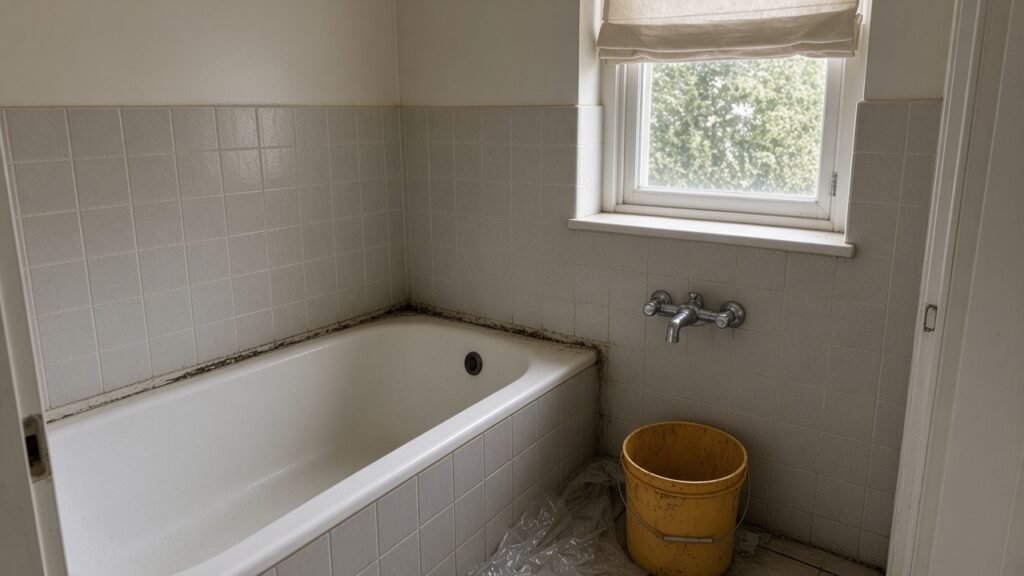
People ask: should I test for mold after remediation? Short answer: yes, if you need a written lab record of a surface you can still reach, or a stain is still sitting there after the work. The U.S. Environmental Protection Agency (EPA) notes that surface sampling may be useful to determine if an area has been adequately cleaned or remediated. A mail-in swab names what is on that patch. It is not a clearance inspection, not a federal pass/fail, and not a medical test.
Do not wipe, scrape, or bleach leftover growth yourself. Disturbing a colony can release spores. Stop active water if you can do that without touching the growth. Then document the surface, then share the report with a qualified mold remediation professional.
By the Total Testing Editorial Team
Quick takeaways
- A swab after cleanup is a lab record of the stain you sampled, not a certificate that the whole house is done.
- The EPA allows that surface sampling can help confirm an area after professional cleanup. That is different from “the job is cleared.”
- Visible leftover growth is a reason to document that surface, not a reason to skip the lab and not a reason to scrub it yourself.
- There are no EPA or other federal limits for mold, so a report cannot prove the home “complies” with a government mold standard.
- The CDC does not recommend routine home testing to predict who will get sick. A species ID is not a diagnosis.
What “after remediation” actually means for a homeowner
Remediation is the contractor’s work: finding the wet material, stopping the water, and removing the colony under containment. Homeowners often hear “we’re finished” and still see a dark line on a vent, a stain on grout, or a musty smell in the same bathroom.
Those leftovers are why people search this question. They want to know whether that remaining patch is still mold, whether it is dirt, and whether they have a paper trail before the wall is closed.
A Total Testing swab answers the first two with inspector-reviewed lab analysis of the surface you mail in. It does not walk the property, open walls, or replace the remediator’s quality check. It is not a formal post-remediation verification. If the remaining question is behind the tub wall, that is a different job.
Where mold still shows up after the crew leaves
Mold needs moisture and a surface it can use as food. In a house, that usually means bathrooms, HVAC grilles, cabinet floors under sinks, windowsills, laundry walls, and — after a leak — baseboards and the edges of wet drywall.
After a job, the original leak may be fixed and the big colony gone, while a smaller stain remains where condensation still forms. Supply registers run cold in summer. Warm indoor air hits that metal and leaves water. Dust plus water can look like dirt, mildew, or mold. Color alone does not tell you which one it is. See mold or dirt around vents and mold vs. mildew.
Bathrooms are the other common leftover. Grout, caulk, the cabinet floor, and the exhaust-fan grille stay damp if the fan is weak or a drip was never in the scope. A swab of the worst remaining stain you can reach still has a job after “the mold was removed.”
Basements and crawl spaces stay humid. Swab only what you can reach without tearing materials or entering a space you are not equipped to enter. EPA’s 24 to 48 hour window still applies after the job: if a new leak or a wet cavity is feeding a surface, growth can return.
What a test after remediation can and cannot tell you
The EPA is clear that sampling is not required before professional cleanup, and that there are no federal limits for mold or mold spores. The same page says surface sampling may be useful after an area has been cleaned. Those two sentences belong together. You are not “failing EPA rules” if you swab a leftover stain. You also cannot use the result to claim the house now meets a federal mold standard, because that standard does not exist.
What the lab can do: identify what was on the accessible surface you sampled, with a written report and a package-specific chain of custody. Every Total Testing analysis is reviewed by a licensed mold inspector. That is inspector-reviewed lab work on the areas sampled. It is not a statement that an inspector walked your rooms.
What the lab cannot do: see inside a closed wall, map a duct run, measure the whole house from one grille, diagnose illness, or declare the home “safe.” Full House (6 samples) is how someone checks several rooms after a larger job. It is still a set of surfaces, not a walkthrough.
If you already have a report from before the work, keep it. A second swab of the same reachable spot is a before-and-after record of that spot, not proof that every other surface is clean. Related: after a positive test and after a water leak.
Health effects: why the report is not a medical clearance
People want the post-cleanup test to mean “we can sleep here now.” That is not what a species name does. The CDC says health effects from mold vary by person. Some people notice irritation or allergy-type symptoms in damp buildings. Others do not. You cannot rely on a home sample to know who will get sick.
The CDC also does not recommend routine home mold testing as a way to predict illness. A Total Testing report does not diagnose a condition, treat a disease, or score the toxicity of your household. If someone in the home is ill, that is a conversation with a clinician, not a lab ID of a vent grille.
This matters after remediation because a “clean” number is not permission to skip moisture control. If the leak or the wet material is not actually dry, growth can return.
Prevention after the work: moisture only
Prevention is not a second round of scrubbing. Total Testing does not instruct readers to wipe, scrape, bleach, soap, or otherwise DIY-clean leftover growth. Disturbing a colony can put more spores in the room air than leaving it until a qualified remediator handles it.
What you can do without touching the growth: stop the water if you can without touching the colony; dry standing water within 24 to 48 hours the same way; keep indoor humidity in a typical occupied range (EPA often cites about 30% to 50%); do not paint over a remaining stain. After the report, share it with a qualified remediator. If the area is large or may still be hidden, also use a licensed mold assessor.
Why the test still matters after a contractor has already been there
Homeowners order a post-cleanup swab for three practical reasons.
First, species ID of a stain they can still see. Dirt, mildew, and mold can look similar in a phone photo. The lab names what was on that surface so the next conversation with the remediator is a finding, not a guess.
Second, a written record. A chain-of-custody report dates the surface you sampled. It is not a court order and not a finding that anyone must act. It is still more than a text thread.
Third, inspector-reviewed lab analysis instead of a petri dish. Settle plates grow ordinary indoor spores. They do not tell you whether the remaining bathroom stain is the growth the crew was hired to remove. See petri dish kits and kit accuracy.
Limits sit next to those uses. The sample is the surface you touched, not a wall cavity and not an on-site walkthrough. If the remaining problem is behind finished drywall, stop. Do not cut the wall to get a better swab.
How to choose what to swab after cleanup
Swab the worst leftover stain you can reach without scraping: the grille face, the grout line, the cabinet floor, the windowsill, the baseboard edge. Label the bag with the room and the exact spot. If two rooms were in the original scope, sample both. Do not swab a brand-new painted surface that no longer shows the area that was treated; that result is the paint, not the old colony.
If several rooms were involved, Full House (6 samples) is how you check whether more than one leftover surface still shows growth. Extended (4 samples) fits a bathroom plus nearby vents. Spot Check (2 samples) fits one leftover patch plus a second nearby control surface, such as a vent in the same room.
Every package includes accredited laboratory analysis, a package-specific PDF chain of custody, prepaid FedEx shipping, and a report on total-testing-diy.com.
- Spot Check — $189 — 2 swabs — 48 business hours after lab receipt
- Extended — $215 — 4 swabs — 48 business hours after lab receipt
- Full House — $270 — 6 swabs — priority 24 business hours after lab receipt
Official product screening disclaimer
Total Testing DIY surface swab kits are a preliminary screening tool for accessible surfaces. They are not a comprehensive mold assessment, building inspection, indoor air quality study, medical test, clearance inspection, or mold removal service.
Do not disturb visible growth. For removal, use a qualified mold remediation professional under your state and local rules. If moisture may be hidden or the area is large, also use a licensed mold assessor.
Frequently asked questions
Should I test for mold after remediation?
Yes if you need a written lab record of a reachable surface after the work, or a stain is still visible. The EPA notes that surface sampling may be useful after an area has been cleaned. A swab names that surface. It is not a clearance inspection and cannot prove the house is safe.
Is a mail-in swab the same as a mold clearance test?
No. Clearance or post-remediation verification is a planned inspection, often with moisture checks and a sampling design. A Total Testing swab is inspector-reviewed lab analysis of the stain you sample. It does not mean an inspector walked the property.
When is a swab useful after cleanup?
When a stain remains on a grille, baseboard, grout line, or cabinet you can reach, and you want a species ID or a document to share with the remediator, a landlord, or a buyer. Visible leftover growth is a reason to document that surface.
Can a lab report prove the remediator finished the job?
No. A report identifies what was on the patch you swabbed. It cannot certify every wall cavity, every duct, or the whole house. There are no EPA or federal mold limits, so a result cannot show that the work “passed” a government standard.
Should I swab before the contractor closes the wall?
If you can still see and reach the treated surface, that is the moment a swab can still name it. Once drywall is closed, a surface kit cannot see inside the cavity. Hidden work belongs with a qualified remediator or licensed assessor, not a mail-in swab of the new paint.
What if the area looks clean but still smells musty?
A musty odor can mean moisture is still somewhere you cannot see. Swab any damp or stained edge you can reach without disturbing growth. A swab of a clean-looking wall does not prove the cavity behind it is dry. See your house smells musty but you cannot see mold.
Can I wipe leftover spots before I send a sample?
No. Total Testing does not recommend wiping, scraping, or bleaching leftover growth. Disturbing a colony can release spores. Stop active water if you can do that without touching the growth, swab what you can reach, then share the report with a qualified remediator.
Does a species ID after remediation tell me if my family will get sick?
No. The CDC does not recommend routine home mold testing to predict who will get sick. Effects vary by person. A species name on a report is not a health risk score and is not a diagnosis.
How many samples do I need after a multi-room job?
Each swab is one surface. Spot Check is two samples ($189). Extended is four ($215). Full House is six ($270) and is how you check several rooms after a larger job. Label every bag with the exact spot.
Where do I get the lab report?
After the accredited laboratory receives the samples, the digital report posts to your account at total-testing-diy.com. Spot Check and Extended post within 48 business hours of lab receipt. Full House uses priority 24 business hour lab processing. Every analysis is reviewed by a licensed mold inspector.
Document the leftover stain. Do not guess it is gone.
If the crew has left and a stain you can still reach is the open question, swab that stain. Keep the moisture off. Let a qualified remediator handle any remaining colony.
Choose a package on total-testing.com. If you already ordered, the report posts at total-testing-diy.com.