
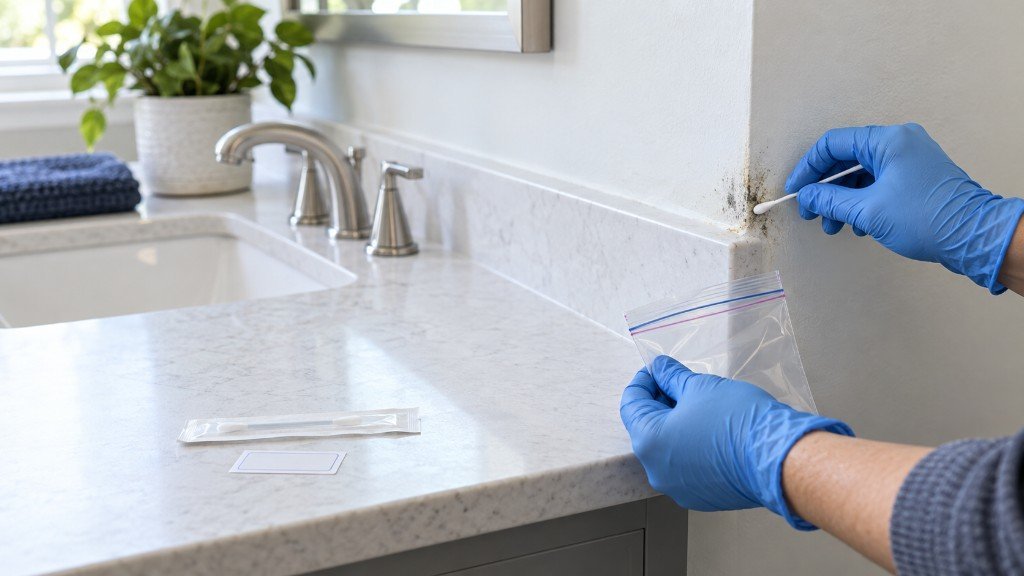
People ask: are home mold test kits accurate? Short answer: it depends on the kit and on the question. A settle-plate (petri dish) kit left open in a room will usually grow something, because spores are already in indoor air. That is not a reliable yes-or-no for “does my house have a mold problem?”
A surface swab of a specific stain, sent to an accredited laboratory, can identify what is growing on that 2×2 inch patch. It cannot see inside walls, measure the whole house, or tell you whether anyone will get sick. If you can already see growth, a swab is still the right next step when you need a lab record for a landlord, or you want to know what you are handing to a remediation professional. Do not scrape or wipe the growth yourself. The U.S. Environmental Protection Agency (EPA) notes there are no federal mold limits, so a kit cannot certify that a home is “safe.”
At Total Testing, the working rule is Test Before You Guess — and only when a sample of a real surface will change what you do next.
By the Total Testing Editorial Team
Quick takeaways
- Accurate for what? A kit can be accurate for the sample you collected. It is not a whole-house inspection and not a health diagnosis.
- Settle plates grow ordinary indoor spores. A fuzzy dish is not proof of a hidden infestation.
- Mail-in surface swabs can identify mold on the exact stain you swabbed, if the lab method is sound and the chain of custody is clear.
- If you can see it, swab that patch for a lab ID and a document you can share. Do not scrape or wipe the growth; leave removal to a qualified mold remediation professional.
- There are no federal mold limits, so no kit can certify that a home “passes” a government mold standard.
What “accurate” can and cannot mean
Homeowners usually want one of three answers: Is this stain mold? How bad is the house? Is it making us sick?
A consumer kit can help with the first question when you swab the stain itself. It cannot reliably answer the second or third.
The EPA states that standards or threshold limit values for airborne mold have not been set, and sampling cannot be used to check a building against federal mold standards. The CDC does not recommend routine home mold testing. Health effects vary by person, and a species name on a report is not a medical result.
If a kit’s marketing implies that a color change, a photo, or a colony count means your home is safe or unsafe, that claim is stronger than the science.
Three things people call a “mold test kit”
Most confusion comes from treating very different products as the same test.
| What you bought | What it actually measures | When the result is useful |
|---|---|---|
| Open petri dish / settle plate | Spores that happen to land on the plate from room air | Rarely. Indoor air already has spores. Growth on the plate is expected. |
| Mail-in surface swab (lab analysis) | What is on the specific 2×2 inch patch you swabbed | When you need to tell mold from dirt, mildew from mold, or want a written lab record of that surface. |
| Licensed on-site inspection | Moisture sources, hidden growth, and a sampling plan designed for that building | When the area is large, growth may be hidden, or you need a professional assessment for a sale, lease, or insurance file. |
Total Testing is the middle row: a DIY surface swab with accredited laboratory analysis, a package-specific PDF Chain of Custody form, and prepaid FedEx return shipping. It is preliminary surface screening. It is not a substitute for a licensed mold assessment, a structural inspection, or an indoor air quality study.
When a kit cannot answer the question
The EPA’s sampling page notes that sampling is not required before professional cleanup, and that there are no federal mold limits. That is not the same as “skip the lab.” Skip a kit when the kit cannot do what you need:
- You want a number that “proves the air is safe.” No consumer kit can issue that number against a federal limit, because none exists.
- You need a licensed inspection of hidden cavities, ducts, or the whole building. A mail-in swab of one stain is not that inspection.
- You already have a licensed assessor’s sampling plan. Follow that plan instead of a random consumer kit.
Visible growth is still a reason to swab if you need a written record of that surface. More: do I need to test if I can already see it?
When a lab swab is the honest next step
A targeted swab is useful when the result will change a decision:
- The spot might be dirt, soot, or mildew, and you want a laboratory identification before you tear out drywall. See mold vs. mildew.
- You need a written record of a specific accessible surface for a landlord, a buyer, or a cleanup check after remediation. EPA notes that surface sampling can help confirm an area was cleaned.
- You cannot see growth, but a surface you can reach looks stained or stays damp (cabinet toe-kick, vent grille, windowsill). A swab of that surface is still only that surface — not the wall cavity behind it.
If the affected area is large, if you suspect hidden moisture, or if anyone in the home has a health concern you think is related to the building, talk to a licensed mold assessor. A mail-in kit does not replace that visit.
How a Total Testing swab is collected
Accuracy starts with the sample, not the shopping cart.
- Choose the exact stain or damp edge. Do not swab random clean drywall “just in case.”
- Roll a clean swab across a 2×2 inch patch with light pressure. Put it in a labeled clean bag.
- Fill out the package-specific PDF Chain of Custody form so the lab knows where each swab came from.
- Ship with the prepaid FedEx label. The digital report posts to total-testing-diy.com after the lab receives the physical samples.
Step-by-step photos: how to collect a surface mold sample. Common errors (touching the swab, sampling dust instead of the stain, skipping the form): seven DIY testing mistakes.
Packages if a surface sample is the right tool
Every package includes accredited laboratory analysis, a package-specific PDF Chain of Custody form, prepaid FedEx express return shipping, and a digital report. There is no separate lab invoice.
- Spot Check ($189 / 2 samples): One or two stains. 48 business hour lab turnaround after receipt.
- Extended ($215 / 4 samples): Several rooms or a stain plus nearby vents. 48 business hour lab turnaround after receipt.
- Full House ($270 / 6 samples): More coverage across the home. Priority 24 business hour lab processing after receipt.
Official product screening disclaimer
Total Testing DIY surface swab kits are a preliminary screening tool for accessible surfaces. They are not a comprehensive mold assessment, building inspection, or indoor air quality study, and they are not a medical test.
If the report shows mold on the sampled surface, or if you have visible growth, water damage, a persistent musty odor, or ongoing moisture, stop active leaks if you can do so without disturbing the growth. Do not scrape, bleach, or wipe visible mold yourself. Share the report with a qualified mold remediation professional. For large or hidden problems, also use a licensed mold assessment professional under your state and local rules.
Frequently asked questions
Are cheap petri dish mold test kits accurate?
A settle plate left open in a room will usually grow mold because indoor air already contains spores. That result does not tell you whether a specific stain is mold, how large a problem is, or whether anyone in the home will get sick.
If I can already see mold, do I still need a test kit?
Yes if you need a written lab record of that stain — for a landlord, a lease, a buyer — or you want species identification before you hire remediation. Visible growth is a reason to document the surface, not a reason to skip the lab. Do not scrape, bleach, or wipe the growth yourself. Disturbing mold can release spores.
Can a home mold test kit tell me if my house is safe?
No. There are no EPA or other federal limits for mold or mold spores, so a kit cannot prove a house meets a federal mold standard. The CDC also does not recommend routine home mold testing to predict health risk. A surface swab identifies what was on the patch you sampled.
Where do I get my Total Testing lab report?
After the accredited laboratory receives your physical samples, the digital report is uploaded to your account at total-testing-diy.com. Spot Check and Extended reports post within 48 business hours of lab receipt. Full House uses priority 24 business hour lab processing.
Test the stain — not the room air
If you already see mold, swab that stain for a laboratory identification and a document you can share. Do not scrape or wipe the growth. Do not expect a dish left on the kitchen counter to name a patch on the wall.
Choose a package at total-testing.com/packages. If you already ordered, download your Chain of Custody form and view reports at total-testing-diy.com.