
How to get fast, lab-verified clarity on household mold—without high-pressure sales pitches, unneeded inspection fees, or panic.
By the Total Testing Editorial Team | Medically & Environmentally Grounded Guide
Key Takeaways
- Test Before You Guess: At-home mold testing provides objective, accredited laboratory analysis on specific problem spots before you invest in expensive remediation or full inspection services.
- When to Test: Sampling is ideal when you notice musty odors, suspicious staining, recent water leaks, or want to verify that a surface cleanup was successful.
- How Surface Sampling Works: You swab a 2×2 inch surface, seal the swab in a labeled bag, attach a unique prepaid FedEx shipping label, and receive lab results in 24 to 48 business hours after receipt.
- Moisture Is the Root Cause: Mold cannot grow without water; drying damp materials within 24 to 48 hours is essential to prevent recurring growth.
- Screening Tool Clarity: DIY mold surface testing is a preliminary screening tool for sampled surfaces—not a substitute for a licensed professional assessment.
1. The Homeowner’s Dilemma: Spot, Smell, or Water Leak?
Finding a dark spot under the bathroom sink, noticing a persistent musty odor in the basement, or dealing with the aftermath of a plumbing leak can spark immediate concern. Many homeowners wonder whether a minor stain is harmless mildew or a serious fungal issue—and whether they need to pay hundreds of dollars for a professional inspector just to look at a single spot.
When homeowners search for at-home mold testing, they are looking for practical clarity and cost transparency rather than alarmist marketing.
The core philosophy of smart home maintenance is simple: “Test Before You Guess.” Instead of assuming the worst or jumping into expensive contractor quotes, at-home mold testing allows you to collect surface samples privately and submit them for accredited laboratory analysis.
2. Understanding Household Mold: Causes, Types, and Risks
To make informed decisions about your home, it helps to understand how mold operates.
Why Mold Grows Indoors
Molds are microscopic fungi that play a vital role outdoors by breaking down organic matter like leaves and wood. Outdoors or indoors, mold spores float continually through the air. However, indoor mold growth only occurs when spores land on surfaces that provide two things:
- Moisture (leaks, condensation, high humidity).
- Cellulose or Organic Food Sources (drywall, wood, carpet, wallpaper, ceiling tiles).
Common Indoor Mold Species
While thousands of mold species exist, a few are frequently encountered in residential spaces:
- Cladosporium: Often brown, green, or black, thriving in both cool and warm locations on wood, fabrics, and HVAC ducts.
- Penicillium: Typically blue or green with a velvety texture, commonly appearing on water-damaged building materials, carpet, and insulation.
- Aspergillus: Appears green, white, or gray with a powdery texture, frequently found on drywall, dust, and clothing.
- Stachybotrys chartarum (often called “black mold”): A dark green or black fungus that grows on materials with high cellulose content (like drywall or paper) after prolonged moisture exposure.
Health Impacts and Sensitivity
According to health authorities such as the US Environmental Protection Agency (EPA), the Centers for Disease Control and Prevention (CDC), and the World Health Organization (WHO), mold exposure can affect individuals differently:
- Allergic Responses: Sensitive individuals may experience hay fever-type symptoms, including sneezing, runny nose, eye irritation, coughing, and skin rash.
- Asthma Triggers: Mold spores can trigger asthma attacks in people with pre-existing mold allergies.
- Irritation: Inhaling mold spores or microbial volatile organic compounds (mVOCs)—which create that distinct musty smell—can irritate the eyes, throat, and lungs of both allergic and non-allergic individuals.
Medical studies referenced by major health centers indicate that while black mold allergies trigger immune responses similar to other pollen or mold allergies, severe toxic systemic illness from household inhalation is rare. Controlling indoor moisture remains the primary defense against all mold types.
3. Should You Test for Mold? (When to Test vs. When to Skip)
One of the most frequent questions homeowners ask is whether testing is actually necessary.
EPA and Extension Guidance
Visible growth is still a reason to swab that surface when you need a written lab record for a landlord, a buyer, or a species ID before you hire remediation. The EPA notes that sampling is not required before professional cleanup and that there are no federal mold limits. That is not the same as “skip the lab.” Do not scrape or wipe the growth yourself. Disturbing mold can release spores.
When At-Home Mold Testing Makes Sense
At-home mold testing is particularly useful as a preliminary screening tool in specific scenarios:
- Uncertain Discoloration: You see a spot on drywall, grout, framing, or furniture and want to confirm whether it is active mold growth or an old stain/dirt.
- Musty Odors Without Obvious Source: You smell mold near an HVAC vent, under a sink, or in a basement corner and want to swab suspected surface spots.
- Post-Cleanup Verification: You have cleaned a previously moldy surface and want lab verification that surface spore levels on that spot are back to baseline.
- Pre-Assessment Clarity: You want objective laboratory data about specific areas before deciding whether to hire a full licensed mold assessment professional.
Comparing Assessment Options
| Feature / Aspect | At-Home Surface Testing (Total Testing) | Licensed On-Site Professional Assessment |
|---|---|---|
| Primary Purpose | Preliminary screening of specific sampled surfaces | Comprehensive property-wide inspection & protocol design |
| Process | DIY surface swab collected by homeowner | On-site inspector evaluation, thermal imaging, air/wall cavity study |
| Cost | One-time flat fee ($189 – $270) | Typically $400 – $1,000+ depending on property size |
| Convenience | Private, flexible, no scheduling or home visits | Requires scheduling and an inspector inside your home |
| Analysis | Accredited independent laboratory analysis | Varies (often external lab or local sampling) |
| Best Used For | Targeted spots, visible patches, surface verification | Widespread flooding, hidden wall leaks, legal/real estate disputes |
4. How At-Home Mold Testing Works: The Total Testing Surface Method
Traditional DIY home kits often relied on open petri dishes left in a room, which simply catch ambient dust and yield misleading results because mold spores exist everywhere in indoor air.
Total Testing utilizes a targeted surface sampling approach combined with accredited laboratory analysis:
- No Inspector in Your Home: You collect surface samples on your own schedule without hosting an on-site technician.
- No Kit to Wait For: You don’t have to wait days for a physical box to arrive in the mail before taking action. You can swab problem spots immediately using standard household swabs (such as a Q-tip).
- Prepaid FedEx Return Shipping Included: Every order includes a unique prepaid FedEx return shipping label and a digital Chain of Custody (COC) form.
- Accredited Laboratory Analysis: Samples are processed by an independent accredited laboratory, identifying specific fungal species, relative spore concentrations, and toxicity context.
5. Step-by-Step Guide to Collecting Your At-Home Mold Sample
Collecting a reliable surface sample takes less than 10 minutes when following this standardized workflow:
Choose Package → Get COC & Label → Swab Surface → Ship FedEx → View Lab Report
Step 1: Select Your Testing Package
Visit total-testing.com and select the package that matches the number of problem areas you wish to test.
Step 2: Receive Chain of Custody (COC) & Shipping Label
Upon purchase via secure Stripe checkout, you immediately receive your unique Chain of Custody (COC) form and a prepaid FedEx return shipping label via email and inside your customer portal dashboard at total-testing-diy.com. Each purchase generates a new, unique shipping label—never reuse an old label.
Step 3: Collect the Surface Sample
- Put on protective disposable gloves.
- Label a clean Ziploc bag with the specific sample location (e.g., “Master Bathroom Sink Drain” or “HVAC Supply Vent”) using a Sharpie.
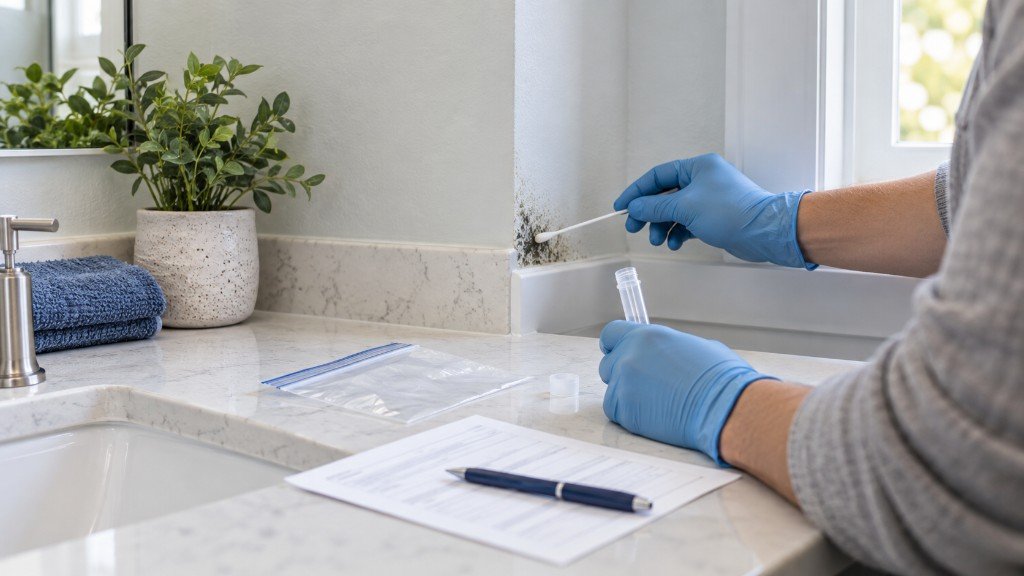
- Take a sterile swab or Q-tip and gently swab a 2×2 inch patch on the target surface.
- Place the swab directly into its designated labeled Ziploc bag and seal it tightly. Use one swab per location.
- Complete and sign the Chain of Custody (COC) document, recording each sample location.
Step 4: Pack and Ship via FedEx
Place your sealed sample bags and signed COC document into a shipping envelope or box, attach the prepaid FedEx label, and drop it off at any official FedEx location or drop box.
Step 5: Receive Your Accredited Lab Report
Once the laboratory receives your shipment, you receive a “samples received” notification. Depending on your chosen package, your comprehensive Mold Surface Testing Report will be published to your secure portal at total-testing-diy.com within 24 to 48 business hours after lab receipt.
6. Package Options: Choosing the Right Sample Count for Your Home
Every Total Testing package includes full accredited lab analysis, digital Chain of Custody materials, prepaid return shipping, and an actionable report. The primary differences are the number of surfaces sampled and lab turnaround time:
| Package | Samples | Price | Lab Turnaround* | Best Suited For |
|---|---|---|---|---|
| Spot Check | 2 | $189 | 48 business hours | Single isolated area |
| Extended | 4 | $215 | 48 business hours | Key spots across home |
| Full House | 6 | $270 | 24 business hours | Broad coverage & priority |
*Turnaround time begins after the laboratory receives the physical samples.
- Spot Check (2 Samples | $189): Perfect if you have one isolated area of concern—such as a single patch behind a toilet or on an attic rafter—plus a control surface.
- Extended (4 Samples | $215 – Most Popular): Ideal for standard residential homes. Allows you to sample four distinct areas, such as the bathroom ceiling, under the kitchen sink, an HVAC return vent, and a basement wall.
- Full House (6 Samples | $270): Provides broad property coverage for larger homes or multiple suspect zones, with prioritized 24 business hour lab turnaround.
7. How to Interpret Your Lab Report and Take Action
When your report is ready on total-testing-diy.com, you will find a structured, easy-to-read breakdown of your samples:
- Identification of Fungal Species: Clear listing of specific molds identified on the sampled surfaces (e.g., Aspergillus, Penicillium, Cladosporium).
- Toxicity & Exposure Context: Educational explanations regarding whether identified species produce common allergens, irritants, or mycotoxins.
- Relative Surface Concentration: Analysis of spore counts and growth density on the sampled areas.
- Actionable Next Steps: Clear guidance on whether the surface requires standard detergent cleanup, material removal, or further professional consultation.
8. Required Product Limitations and Official Screening Disclaimer
To maintain total transparency and adhere to environmental industry standards, homeowners must understand what DIY surface testing provides:
Official Screening Disclaimer
The Total Testing DIY Mold Test Kit is intended solely as a preliminary screening tool to help identify the possible presence of mold on sampled surfaces. It provides an initial understanding of potential mold contamination on specific tested spots and should not be considered a substitute for a comprehensive mold assessment by a licensed mold professional.
Scope Limitations: DIY surface testing does not evaluate overall indoor air quality, measure airborne mold spore counts throughout a building, or detect concealed mold hidden inside walls, ceilings, floor cavities, or inaccessible HVAC ductwork. Findings apply strictly to the surfaces sampled at the time of collection.
When to Consult a Professional: If lab results show mold on a sampled surface, or if your home has water damage, ongoing leaks, persistent musty odors, visible growth, or occupants with building-related health concerns, share the report with a qualified mold remediation professional. Do not scrape or wipe the growth yourself. For hidden moisture or a large area, also use a licensed mold assessment professional per applicable state and local regulations.
9. The Moisture Control Blueprint: Preventing Mold Return
Testing and cleaning mold on a surface is only half the battle. If you clean the mold without resolving the underlying moisture issue, the mold will inevitably return.
EPA & CDC Moisture Prevention Guidelines
- Act Quickly on Water Leaks: Clean up spills and dry water-damaged materials within 24 to 48 hours to prevent mold spores from germinating.
- Maintain Low Relative Humidity: Keep indoor humidity levels between 30% and 50% (and strictly below 60%) using air conditioners and dehumidifiers. Use an inexpensive hygrometer to track room moisture.
- Improve Ventilation: Always run exhaust fans in bathrooms and kitchens during and after cooking or showering, venting moisture directly outdoors.
- Clean & Maintain HVAC Systems: Keep air conditioning drip pans clean and drain lines unobstructed. Service heating and cooling units regularly and replace filters as recommended.
- Ensure Exterior Drainage: Clean roof gutters regularly and ensure the ground slopes away from your foundation so rainwater drains away from the house.
Do Not Clean Visible Growth Yourself
If your lab report confirms surface mold, do not scrape, bleach, or wipe it. Disturbing growth can release spores into the air. Total Testing does not instruct homeowners to remove mold.
- Share the report: Give it to a qualified mold remediation professional.
- Stop active water if you can do so without touching the colony (shut a valve, run a dehumidifier).
- Do not paint over it.
- If moisture may be hidden or the area is large, also use a licensed mold assessor.
10. Frequently Asked Questions (FAQ)
Q1: Is at-home mold testing accurate?
Yes, when surface samples are analyzed by an independent accredited laboratory. Unlike legacy open petri-dish kits, targeted surface swab sampling captures actual fungal growth on specific spots, allowing certified microbiologists to identify exact fungal genera and species.
Q2: How long does it take to get mold test results?
With Total Testing, results are delivered within 24 to 48 business hours after the laboratory receives your samples, depending on whether you choose the Spot Check, Extended, or Full House package.
Q3: What is the difference between toxic black mold and regular mold?
“Black mold” typically refers to Stachybotrys chartarum, a dark green or black fungus that grows on damp cellulose materials. While it produces mycotoxins, health agencies note that all indoor molds—regardless of color or species—can cause allergic reactions and respiratory irritation and should be removed.
Q4: Can I test my indoor air with a surface swab?
No. Surface swabs collect mold spores and physical growth directly from hard or soft surfaces. They do not measure volumetric airborne spore counts. However, swabbing supply vents or fan blades can help indicate whether mold is present near air distribution points.
Q5: How much does professional mold remediation cost compared to testing?
Full professional mold remediation typically costs between $500 and several thousand dollars depending on the extent of damage. At-home surface testing ($189–$270) serves as an affordable first step to determine what is on your surfaces before committing to expensive contractors.
Ready to Get Objective Clarity on Your Home?
Don’t let uncertainty or high-pressure sales pitches cause unnecessary stress. Take control of your indoor environment with lab-verified facts.
Start Your DIY Mold Test Today at total-testing.com — Choose your package, collect your swab samples in minutes, and receive your accredited laboratory analysis with an easy-to-read action plan.
Already ordered or checking existing sample results?
Log in to the Customer Portal at total-testing-diy.com to download your Chain of Custody forms, track shipment status, or view your completed lab reports.
For additional questions or customer support, contact us at info@total-testing.com or reports@total-testing.com.