
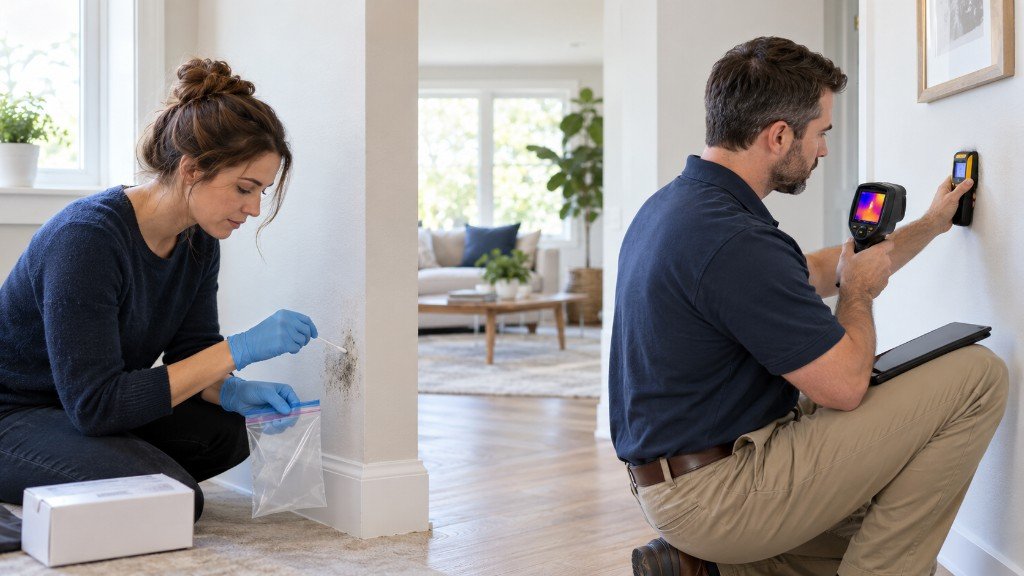
Finding a dark spot under the bathroom sink, noticing wall discoloration, or smelling a persistent musty odor in the basement often brings up an immediate question for homeowners: Do I need to pay hundreds of dollars for a full professional mold inspection, or can I get the answers I need with an at-home mold test kit?
Navigating indoor air quality concerns shouldn’t feel overwhelming, expensive, or scary. Both DIY surface sampling and licensed professional inspections serve valuable roles in home maintenance, but they are built for entirely different situations, budgets, and goals.
Understanding the differences between preliminary surface screening and full site assessments empowers you to make an informed, cost-effective decision without overpaying or guessing about your home’s health.
By the Total Testing Editorial Team
Quick Summary: DIY Surface Testing vs. Professional Inspection
| Feature / Consideration | DIY Mold Testing (Total Testing) | Licensed Professional Inspection |
|---|---|---|
| Primary Goal | Fast, private lab verification of visible surface spots or odors | Comprehensive building investigation, thermal imaging, and air study |
| Total Cost | $189 to $270 flat rate (all-inclusive) | $300 to $1,000+ per assessment visit |
| Turnaround Time | 24 to 48 business hours after lab receipt | 3 to 7+ business days after on-site visit |
| Inspector Visit Required? | No inspector in your home; 100% private sampling | Yes; requires scheduled 2 to 4 hour on-site walkthrough |
| Hidden Shipping Fees? | None (prepaid FedEx express return label included) | N/A (samples collected directly on-site) |
| Best Used For | First-step screening, visible spots, targeted problem areas | Major flooding, hidden wall leaks, legal or real estate transactions |
| Official Role | Preliminary lab-backed surface screening tool | Full environmental assessment and structural investigation |
Understanding the Two Approaches
What Is DIY Mold Testing?
DIY surface mold testing allows homeowners and tenants to collect physical samples from specific problem areas—such as a stained wall, a damp bathroom tile grout line, an HVAC vent cover, or under a sink—and send them directly to an accredited environmental laboratory for microscopic identification.
At Total Testing, our process focuses on targeted swab surface sampling. You swab a 2×2 inch patch of the suspicious area, register your sample details through a digital Chain of Custody (COC) in the secure user portal at total-testing-diy.com, and drop your package off using an included prepaid FedEx express return shipping label. Within 24 to 48 business hours after the accredited laboratory receives your samples, you access a clear digital report breaking down exact mold species, spore levels, and practical next steps.
Our guiding principle is simple: Test Before You Guess. Surface sampling provides lab-backed facts so you don’t spend money on unnecessary professional fees or remediation work before knowing what is actually growing.
What Is a Professional Mold Inspection?
A professional mold inspection is an extensive, on-site evaluation conducted by a licensed environmental assessor or certified industrial hygienist. During an inspection, the professional performs a physical walkthrough of the property, taking moisture readings across building materials, using infrared thermal imaging cameras to locate hidden water leaks inside wall cavities, and running specialized air volume pumps to collect indoor and outdoor airborne spore controls.
Professional inspections are highly thorough, but they come with significant costs, scheduling commitments, and detailed technical documentation intended for legal disputes, insurance claims, or major structural remediation projects.
Detailed Side-by-Side Comparison
1. Cost & Price Transparency
- DIY Surface Testing: Offers complete price transparency with a flat rate ranging from $189 to $270. Every package includes sterile surface swabs, digital Chain of Custody registration, prepaid FedEx express return shipping, accredited laboratory microbiology analysis, and easy-to-read digital reports. There are no hidden lab fees or recurring subscription costs.
- Professional Inspection: Typically costs between $300 and $1,000+ depending on property size, regional rates, and the number of air or surface samples collected. Additional laboratory analysis fees ($50 to $100 per air cassette) are often added to the base inspection cost.
2. Speed & Convenience
- DIY Surface Testing: Requires zero scheduling. You collect samples on your own timeline without waiting for an inspector to visit your home. Turnaround is rapid: reports are published to your portal in 24 to 48 business hours after the laboratory receives your shipment.
- Professional Inspection: Requires booking an appointment in advance and making yourself available for a 2 to 4 hour walkthrough. Final inspection reports with air cassette analysis usually take between 3 and 7 business days to compile.
3. Scope of Investigation
- DIY Surface Testing: Focuses specifically on the surfaces you choose to swab. It provides precise microscopic species identification for identified problem spots but does not measure airborne spores across unsampled rooms or detect hidden growth concealed behind intact drywall.
- Professional Inspection: Evaluates the entire building envelope, including inaccessible structural cavities, HVAC ductwork interiors, and overall indoor air volume dynamics.
When to Choose DIY Mold Testing
DIY surface mold testing is the ideal first step for homeowners and renters who want fast, reliable, lab-verified answers without high upfront expenses. Consider DIY sampling if:
- You see a specific suspicious spot: You noticed discoloration on a bathroom wall, windowsill, or under a kitchen pipe and want to know if it is active mold before wiping it down.
- You smell a localized musty odor: You smell dampness near a specific cabinet or vent and want to swab nearby surfaces.
- You value privacy and convenience: You prefer to collect samples discreetly on your own schedule without hosting an external inspector inside your residence.
- You want preliminary facts before taking action: You want lab-backed data to determine whether simple household cleaning is sufficient or if professional assistance is warranted.
- You are monitoring clean surfaces after a repair: You fixed a minor plumbing leak and want to verify that a cleaned surface remains free of elevated spore growth.
When to Hire a Licensed Professional Mold Inspector
While DIY surface sampling provides excellent clarity for visible spots, certain complex situations require a comprehensive, licensed professional assessment. You should hire a certified mold professional if:
- Severe or widespread water damage has occurred: Your home experienced major flooding, a burst main pipe, or prolonged roof leaks affecting multiple rooms or structural framing.
- You suspect widespread hidden mold inside walls: You smell a strong mold odor throughout a room but see zero visible staining on any exposed surface.
- Visible mold growth: Do not scrape or wipe it. Share a lab report of that surface with a qualified mold remediation professional. If moisture may be hidden or the area is large, also use a licensed mold assessor.
- The property was damaged by contaminated water or sewage: Cleanup and assessment involving sewage or floodwaters require specialized hazardous containment protocols.
- You need documentation for legal, real estate, or insurance claims: Formal real estate transactions, landlord-tenant disputes, or legal insurance claims usually require signed reports from a licensed state assessor.
EPA & CDC Guidelines for Home Moisture & Mold Prevention
Regardless of whether you choose DIY surface testing or a professional inspection, environmental agencies agree that controlling moisture is the single most critical factor in controlling indoor mold.
The U.S. Environmental Protection Agency (EPA) and Centers for Disease Control and Prevention (CDC) highlight these essential indoor moisture management principles:
- Indoor Relative Humidity: Maintain indoor relative humidity levels between 30% and 50%. Relative humidity can be measured using an inexpensive hygrometer ($10 to $30 at local hardware stores).
- Rapid 24 to 48 Hour Drying: If a water leak or spill occurs indoors, dry all wet materials and structural surfaces within 24 to 48 hours to prevent mold spores from germinating.
- Ventilation: Always operate exhaust fans in bathrooms and kitchens during and after showering or cooking, venting moisture directly to the outside.
- Do not clean visible growth yourself: Do not scrape, bleach, or wipe visible mold yourself. Disturbing growth can release spores into the air. Share your lab report with a qualified mold remediation professional.
- Fix the Underlying Leak: Stop active water if you can do so without touching the colony. Moisture control is not the same as disturbing established growth.
Total Testing Package Breakdown
At Total Testing, we offer three clear, transparent packages designed to fit your home’s specific layout:
- Spot Check ($189 / 2 Samples): Ideal for targeting 1 or 2 specific problem areas, such as a single bathroom sink or window frame. Includes 48 business hour laboratory turnaround after sample receipt.
- Extended ($215 / 4 Samples – Most Popular): Perfect for checking multiple key areas across a standard home, including bathrooms, basements, and HVAC vents. Includes 48 business hour laboratory turnaround after sample receipt.
- Full House ($270 / 6 Samples): Provides comprehensive coverage for larger residences or multiple damp zones, paired with priority 24 business hour laboratory turnaround after sample receipt.
Every package includes full accredited laboratory microbiology analysis, a digital Chain of Custody (COC), prepaid FedEx express return shipping labels, and a clear digital report featuring species breakdown and practical action steps.
Required Product Screening Disclaimer
The Total Testing DIY Mold Test Kit is intended solely as a preliminary screening tool to help identify the possible presence of mold on sampled surfaces. It provides an initial understanding of potential mold contamination and should not be considered a substitute for a comprehensive mold assessment by a licensed mold professional.
Results may indicate further evaluation is warranted. If results show elevated mold growth, or if there is visible mold, water damage, musty odors, ongoing moisture, or health concerns that may relate to indoor conditions, Total Testing strongly recommends a comprehensive inspection by a licensed mold assessment professional per applicable state and local regulations.
Frequently Asked Questions (FAQ)
Can a DIY mold test kit detect hidden mold behind drywall?
No. DIY surface swab kits collect physical spores directly from exposed surfaces. If mold is completely concealed inside an unopened wall cavity or behind wallpaper, a surface swab cannot reach it. Hidden mold investigations require professional tools like thermal imaging cameras or destructive wall cavity sampling.
Is DIY surface sampling accepted as a legal document in court?
While Total Testing uses accredited environmental laboratories, DIY surface kits are designed as preliminary homeowner screening tools. Legal disputes, tenant court cases, or formal insurance claims typically require an official on-site investigation and signed assessment report from a licensed state inspector.
How quickly will I receive my lab results?
Turnaround starts as soon as our accredited laboratory receives your package via prepaid FedEx express shipping. Spot Check and Extended packages deliver digital reports within 48 business hours after lab receipt, while Full House packages receive priority 24 business hour turnaround.
What should I do if my lab report shows elevated mold levels?
Your Total Testing digital report is a laboratory record of the surfaces you swabbed. Stop active leaks if you can do so without disturbing the growth, keep indoor humidity in a typical range, and share the lab report with a qualified mold remediation professional. Do not scrape, bleach, or wipe the growth yourself.
Take Control of Your Home’s Health Today
You don’t need to guess about dark spots or spend hundreds of dollars on an inspector walkthrough just to get initial answers. By using Total Testing’s accredited DIY surface sampling, you get fast, private, lab-verified facts to guide your next decision calmly and confidently.
To select the right testing package for your home, visit total-testing.com. If you already purchased a kit and are ready to complete your digital Chain of Custody or view your lab results, log in to the secure customer portal at total-testing-diy.com.