
Key Takeaway Summary
If you suspect mold on a wall, pipe, window frame, or HVAC vent, you do not need to book an expensive in-person inspector just to get initial answers. You can collect a direct surface swab sample at home and send it to an accredited environmental microbiology laboratory via prepaid express shipping. A professional lab analysis identifies specific fungal species (such as Cladosporium, Penicillium, Aspergillus, or Stachybotrys chartarum) and delivers a clear, actionable report in 24 to 48 business hours after the lab receives your samples.
The Homeowner’s Dilemma: Spotting Mold vs. Knowing What It Is
Over my 30 years as a home maintenance and consumer health writer, I have spoken with hundreds of homeowners facing the exact same sudden panic: you notice a dark patch under the bathroom sink, spot fuzzy growth on a basement baseboard, or catch a persistent musty smell near an air vent.
Your first instinct might be to call a licensed mold inspector immediately—a visit that often costs hundreds of dollars before any actual cleaning even begins. Your second instinct might be to grab a cheap “petri dish” culture kit from a local hardware store.
Unfortunately, over-the-counter culture dishes are notoriously misleading. Because mold spores exist naturally in all indoor and outdoor air, an open-air dish will almost always grow harmless mold, leaving you anxious without providing real answers.
This brings us to a better, more practical question: Where can you send a mold sample for actual accredited laboratory testing—and how does the shipping process work?
Here is your complete, step-by-step guide to finding an accredited environmental microbiology lab, preparing your samples correctly, and getting clear, lab-backed facts without an inspector stepping foot in your home.
By the Total Testing Editorial Team
Where Do Mold Samples Actually Go?
When professional mold remediators or industrial hygienists test a property, they don’t rely on color-changing home strips. They send samples directly to an accredited environmental microbiology laboratory.
These specialized labs employ trained microbiologists who evaluate fungal structures under high-power microscopy. Using analytical methods recognized by professional bodies like the American Industrial Hygiene Association (AIHA), the lab can identify exact mold species, count spore concentrations, and evaluate whether the growth poses elevated indoor risks.
Can You Walk into a Local Microbiology Lab?
While some commercial environmental labs exist in major industrial centers, most do not maintain public drop-off counters for retail homeowners. Furthermore, walking into an independent commercial lab requires you to bring standardized collection materials and an official Chain of Custody (COC) document—a formal tracking record that verifies where, when, and how the sample was collected.
This is why direct-to-lab DIY services like Total Testing were created: to bridge the gap between accredited laboratory science and everyday homeowners.
How Total Testing Connects You Directly to Accredited Lab Testing
Total Testing provides a streamlined, private surface sampling service that delivers accredited laboratory analysis without requiring you to wait for a physical kit in the mail or schedule an on-site inspector.
Guided by the practical philosophy “Test Before You Guess,” the service allows you to swab suspicious spots in your home and send them straight to an accredited lab using prepaid express shipping.
The Total Testing Direct-to-Lab Flow
- Select Package — Choose Spot Check (2), Extended (4), or Full House (6)
- Receive COC & Label — Get official Chain of Custody & unique prepaid FedEx label
- Swab Surface — Roll sterile swab across a 2×2 inch surface patch
- Pack & Ship FedEx — Attach prepaid label; drop at any official FedEx location
- Digital Lab Report — Receive species breakdown in 24–48 hrs after lab receipt
Step-by-Step: How to Send a Mold Sample to the Lab
Sending a mold sample for laboratory analysis is clean, straightforward, and takes less than 15 minutes. Here is how the end-to-end process works:
Step 1: Choose the Right Testing Package
Select a package based on how many suspicious spots or rooms you need to evaluate. Every option includes full laboratory analysis, prepaid return shipping, and official COC materials with a one-time payment (no recurring subscriptions):
| Package Name | Samples Included | Ideal For | Lab Turnaround Time* | Price |
|---|---|---|---|---|
| Spot Check | 2 Samples | Single problem spots (e.g., bathroom sink or HVAC vent) | 48 Business Hours | $189 |
| Extended (Most Popular) | 4 Samples | Multi-room checks or key areas across the home | 48 Business Hours | $215 |
| Full House | 6 Samples | Broader house-wide coverage & fastest processing | 24 Business Hours | $270 |
*Note: Turnaround time begins as soon as the lab physically receives your shipped samples, not at the time of purchase.
Step 2: Access Your Official Shipping & Chain of Custody Documents
Immediately after ordering on total-testing.com, your official Chain of Custody (COC) document and a unique prepaid FedEx shipping label are generated and emailed to you. You can also log into your secure customer portal at total-testing-diy.com under My Inspections to view and download your shipping materials.
Important: Each purchase generates a unique FedEx tracking label. Always use the fresh label created for your current order so the lab can immediately route your samples.
Step 3: Collect Your Surface Swab Sample
You don’t need expensive equipment. You can collect a clean surface sample using simple household items:
- Protect Yourself: Wear disposable gloves before sampling.
- Label the Bag: Take a clean, sealable Ziploc bag and write the specific sample location (e.g., “Master Bath Window Sill”) using a permanent marker.
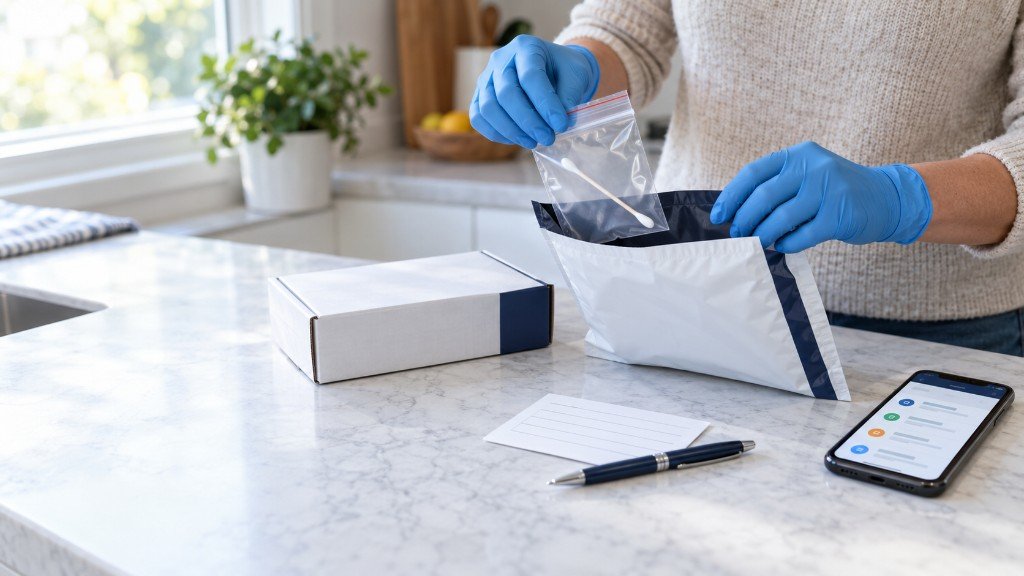
- Swab the Patch: Take a sterile Q-tip or cotton swab, hold it by the stem, and gently roll the tip across a 2×2 inch area of the suspicious spot using light, firm pressure.
- Seal the Sample: Place the swab directly into its labeled bag and zip it tight. Repeat with a fresh swab and bag for each additional sampling location.
- Complete the COC Form: Log into total-testing-diy.com to fill in your property details and matching sample locations. Print and sign the completed COC form to enclose with your shipment.
Step 4: Ship Your Package via FedEx
Place your sealed sample bags along with your signed Chain of Custody form inside a sturdy shipping envelope or box. Apply your prepaid FedEx label to the outside and drop the package off at any official FedEx drop-off counter or location.
Because return express shipping is fully prepaid with your package, there are no hidden shipping fees at the counter.
Step 5: Receive Your Lab-Analyzed Report
Once FedEx delivers your package to the laboratory, you will receive an automated email notification confirming that processing has begun.
Within 24 to 48 business hours after lab receipt (depending on your package), your official Mold Surface Testing Report will be published directly to your secure account at total-testing-diy.com.
What Information Will Your Lab Report Include?
A professional microbiology lab report turns visual uncertainty into actionable clarity. Your Total Testing report will provide:
- Specific Mold Species Identification: Identifies whether the sample contains common indoor molds like Cladosporium, Penicillium, Aspergillus, or elevated water-damage indicators like Stachybotrys chartarum (often called “black mold”).
- Surface Spore Concentration: Evaluates whether fungal growth on the swabbed surface is light, moderate, or heavy.
- Toxicity Context: Explains the biological characteristics of the identified mold types in plain, easy-to-understand language.
- Clear Next-Step Action Plan: Provides practical guidance on whether standard household cleaning, moisture reduction, or professional remediation advice is warranted.
Understanding Product Scope & Limitations
A high-quality testing service is always honest about what DIY surface sampling can and cannot do. Keeping your expectations realistic ensures you make the best decisions for your home:
- What DIY Surface Sampling Does: It serves as a reliable preliminary screening tool to confirm whether a visible spot, stain, or surface growth contains mold and identifies the exact fungal species involved.
- What It Does Not Do: DIY surface sampling is not a substitute for a comprehensive, licensed in-person mold assessment. It does not measure airborne spore counts across an entire building, nor can it detect hidden mold concealed inside unopened wall cavities, ceilings, or HVAC duct interiors.
Official Product Disclaimer
The Total Testing DIY Mold Test Kit is intended solely as a preliminary screening tool to help identify the possible presence of mold on sampled surfaces. It provides an initial understanding of potential mold contamination and should not be considered a substitute for a comprehensive mold assessment by a licensed mold professional.
If lab results indicate elevated mold growth, or if you have extensive visible mold, ongoing water damage, musty odors, or unaddressed health concerns, Total Testing strongly recommends consulting a licensed mold assessment professional in accordance with local guidelines.
The EPA & CDC Blueprint for Household Moisture Control
Finding out what is growing on a surface is only half the battle—stopping future growth requires controlling indoor moisture. According to the U.S. Environmental Protection Agency (EPA) and the Centers for Disease Control and Prevention (CDC):
- Keep Humidity Between 30% and 50%: Molds require moisture to germinate. Use air conditioners or dehumidifiers to keep relative humidity under 50% (and strictly below 60%).
- Dry Leaks Within 24 to 48 Hours: If a pipe leaks or a basement experiences water intrusion, drying all affected building materials within 24 to 48 hours usually prevents mold from taking root.
- Do not clean visible growth yourself: Do not scrape, bleach, or wipe visible mold yourself. Disturbing growth can release spores into the air. Share your lab report with a qualified mold remediation professional. For sewage or flood water, use a qualified professional.
Frequently Asked Questions (FAQ)
Can I drop off a mold sample at a local laboratory myself?
Most commercial environmental microbiology laboratories are non-retail facilities that require pre-established accounts, standardized collection swabs, and formal Chain of Custody documentation. Using a direct-to-lab service like Total Testing provides you with accredited laboratory analysis, prepaid FedEx shipping, and standardized COC forms in one seamless package.
How fast will I get my lab results?
Turnaround times begin once the laboratory physically receives your shipped samples. Spot Check (2 samples) and Extended (4 samples) packages deliver digital reports within 48 business hours after lab receipt. The Full House (6 samples) package features expedited 24 business hour turnaround after receipt.
Do I need a special cold pack or refrigerated box to ship swab samples?
No. Fungal spores on dry surface swabs remain stable during express transit. You do not need cold packs or ice. Simply place your sealed Ziploc sample bags and signed COC paperwork inside a standard shipping envelope, affix your prepaid FedEx label, and drop it off.
Is sending a swab sample better than an air test?
Surface swab sampling is ideal when you can see a specific suspicious spot, stain, or discoloration and want to know what it is. Air testing measures floating spores in ambient room air but does not identify the precise surface origin of the growth. Swabbing gives you a direct, targeted answer for specific surface spots.
Take the First Step Toward Clear Home Answers
If you are dealing with a suspicious spot or musty smell, don’t guess—and don’t spend money on an expensive full-scale inspection until you have basic laboratory facts.
- Need to test a spot in your home? Choose your testing package at total-testing.com.
- Already ordered and ready to submit your details or download your report? Log into the secure portal at total-testing-diy.com.
- Have questions about your shipping label or process? Contact the support team directly at info@total-testing.com or reports@total-testing.com.